What Is Gamified Learning?


If you've been exploring engaging ways to change up your child's learning experience, you've probably come across terms like "gamified learning," "gamification," and "gameschooling." But what exactly is gamified learning, and how can you effectively apply this method to support your child's learning journey?
Gamified learning adds game elements to traditional teaching methods to make learning experiences more interactive and engaging. While this method has gained popularity through the rise in e-learning, it has been widely employed even before technology was used in education. Leading expert, Karl Kapp, states that gamified learning can be used to "engage people, motivate action, promote learning, and solve problems".
Board games, flashcards, and card games are very commonly used in classrooms to keep children interested and engaged.
Common features of gamified learning include:
- Tasks, quizzes, and quests that encourage children to earn points, improve rankings, or collect character accessories.
- Competitions, which encourage children to stay motivated (Kahoot is a great example).
- Team-building activities delivered through multiplayer games or group quests.
- A sense of community and increased social interaction, especially beneficial for homeschooled children.
- Immediate feedback after completing a task, providing useful progress statistics to homeschoolers and teachers, using leaderboards and progress bars.
How does gamified learning differ from other types of learning?
In the world of education, gamified learning is a standout approach that breaks away from the traditional mold. It's not a one-size-fits-all model; instead, it tailors the learning experience to each child, making their educational journey personal and interesting.
Gamified learning improves information retention by ensuring that children understand different topics presented to them in a bitesize format (also known as microlearning). This approach allows children to learn and practice new knowledge without the pressure of giving the right answer in front of their peers, while eliminating basic limitations, such as handwriting. The use of game elements helps address learning objectives in a more effective and engaging way, which is something traditional methods often struggle to do.
Another clear advantage is providing children with a dynamic learning environment. Instead of a static, textbook-focused setting, gamification invokes the same feelings as video games. By including challenges, rewards, and competition in different online courses, gamified learning grabs children's attention and encourages them to actively participate.
Gamification also improves student engagement. The captivating stories, instant feedback, and sense of progress in gamified platforms keep children focused on what they’re learning. This results in a more immersive educational experience where young learners willingly make an effort to overcome challenges and achieve their goals.
Gamification strategies inspired by the success of video games have the potential to transform traditional and online learning. By understanding how these gamification elements create a dynamic and responsive learning experience for children, we can help students improve their knowledge retention and cultivate a genuine enthusiasm for learning!
Why is gamified learning effective?
Gamified learning can be more effective than traditional forms of education. This is because the game-playing format takes educational topics, like spelling, grammar, or text structure, and turns them into enjoyable content that boosts learner engagement. Unlike traditional teaching methods, which can be challenging to deliver and adapt to different students, gamified learning has proven to be a highly effective way to cater to different learning styles and levels simultaneously. OECD states that "a student who is engaged is primed to learn; a student who is disengaged is not", and this is highly relevant in supporting gamification as a teaching and learning method.
Here are some ways in which gamified learning has succeeded in improving skills development:
- Games that make learning enjoyable: Most children naturally enjoy games, making the learning process more enjoyable and engaging.
- Focus: Gamified learning provides a clear goal, resulting in increased focus.
- Friendly competition: Competition, a common element in games, serves as a great way to instil intrinsic motivation, and encourages critical thinking and problem-solving skills.
- Say bye to boring: Traditional teaching methods often make learning seem boring or tedious. Gamified learning challenges this perception by making education fun!
- Flexible learning: As gamified learning is often digital, it offers flexibility and accessibility, allowing students to learn at their own pace, and from anywhere in the world.
- Global connections: Online educational games provide a platform for children to connect globally, fostering diverse learning experiences and perspectives.
- Personalized challenges: Games progress in difficulty, offering personalized challenges based on individual aptitude, a feature absent in traditional classroom settings.
Myths Debunked
There is a lot of misinformation or preconceptions about gamified learning as being unproductive, distracting, or less effective than traditional methods. However, research has shown it to be an effective method for learning across various ages. Let's take a look:
1. Myth: Gamified learning is just playing games.
Games are the tool, not the goal. Well-designed learning games use challenges, rewards, and repetition to help children develop real skills while keeping them motivated to practice consistently.
2. Myth: It's just more screen time.
Educational screen time is different from entertainment. Instead of passively watching, children are actively reading, writing, solving problems, and reinforcing what they've learned.
3. Myth: Rewards distract children from learning.
Rewards celebrate progress, encourage persistence, and help build positive learning habits. They motivate children to keep learning while the focus stays firmly on developing skills.
4. Myth: Gamified learning is less effective than traditional teaching methods.
Gamified learning works best alongside traditional teaching. It complements classroom/home learning by increasing engagement, encouraging regular practice, and providing instant feedback.
5. Myth: Gamified learning is only for struggling learners.
Children of all abilities can benefit. It provides extra support where it's needed while offering more advanced challenges to help confident learners continue to grow.
6. Myth: Children won't learn without games.
Gamification isn't a replacement for traditional learning - it's a way to make learning more engaging. By building confidence and curiosity, it encourages children to apply their skills both on and off the screen.
How Night Zookeeper can help
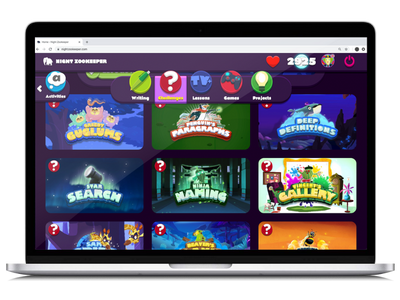
Night Zookeeper uses gamification to make reading & writing fantastically fun for children aged six to twelve!
Our reading & writing program provides children with a gamified learning experience through thousands of award-winning educational games that boost engagement and build skills.
We use gamification elements like adjustable difficulty levels, real-time tracking, competitions, leaderboards, and awards to keep children entertained as they learn.
Sign up today to get a FREE 7-day trial!
Got any questions? Email us at [email protected] or reach out to us on social media:
For further information on gamified learning, please refer to the sources below:
D’Mello, Sidney K (2021) Improving student engagement in and with digital learning technologies. OECD Digital Education Outlook. [online] OECD. Available at: https://www.oecd.org/en/publications/oecd-digital-education-outlook-2021_589b283f-en/full-report/component-7.html
Kapp, Karl (2014) Engagement: A Critical Element in Learning and Gamification. [online] Available at: https://karlkapp.com/engagement-a-critical-element-in-learning-and-gamification/
Fadhli, Muhibuddin, Brick, Billy, Setyosari, Punaji, Ulfa, Saida and Kuswandi, Dedi (2020) A Meta-Analysis of Selected Studies on the Effectiveness of Gamification Method for Children. International Journal of Instruction, 13 (1). ISSN e-ISSN: 1308-1470 p-ISSN: 1694-609X http://e-iji.net/dosyalar/iji_2020_1_54.pdf
Landers, R. N. (2014) ‘Developing a Theory of Gamified Learning: Linking Serious Games and Gamification of Learning’, Simulation & Gaming, 45(6), pp. 752–768. doi: 10.1177/1046878114563660.
FutureLearn, 2021. What is gamification in education? - FutureLearn. [online] FutureLearn. Available at: <https://www.futurelearn.com/info/blog/general/gamification-in-education>
Wright, C., n.d. Game-based Learning vs Gamification: What’s the Difference?. [online] Blog.mindresearch.org. Available at: <https://blog.mindresearch.org/blog/game-based-learning-vs-gamification>
Trueeducationpartnerships.com. n.d. [online] Available at: <https://www.perfectlyimperfectproduce.com/schools/gamification-in-education>


Make Reading & Writing Fantastically Fun!
- Award-winning reading & writing program for kids
- Improves spelling, grammar, punctuation & vocabulary
- Over 1,000 different learning games and activities


“My child hates writing.” What do I do?


Homeschool vs Unschool vs Gameschool


Why Gamification Helps Children with Special Educational Needs