The Stages of Writing Development


Writing development begins far earlier than most parents expect. Knowing what to look for can help you support your child at each stage of their writing journey.
When do kids start writing?
Those wiggly lines and swirling loops your toddler creates? They’re not just scribbles - they’re the very first steps in learning to write.
Most of us associate "writing" with the moment a child puts recognisable letters on a page. But developmental experts tell us that the foundations of writing are laid from around 15 months of age, long before learning the alphabet at school or learning how to hold a pencil properly.
It begins with scribbling. Then shapes. Then letter-like marks. Then real letters. Then words. Each stage builds naturally on the last, and every child moves through them at their own pace.
So the next time you see your little one clutching a chunky crayon and dragging it enthusiastically across a piece of paper (and perhaps also across your wall), know that something genuinely important is happening!
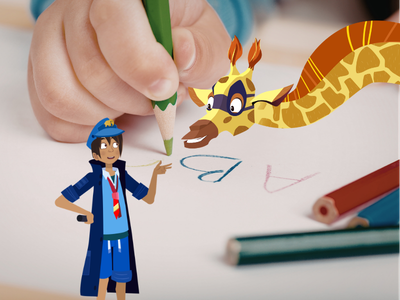
The stages of writing development
Here's a guide to the key stages most children move through on their writing journey, along with ages to expect them (and a handy tip for each one).
Around 15 months - 2 years
✍️ Random scribbling
This is where it all begins. Your child grasps a crayon in their fist and discovers that moving it across paper makes something happen - a permanent mark! These early scribbles aren't just a mess... they're a sign that fine motor skills are developing and that your child is beginning to understand the idea of making a record of something.
💡 TOP TIP: Keep crayons and plenty of paper within reach. Once they've scribbled something, ask what they've drawn/written and listen with genuine curiosity.
Around 2 - 3 years
✍️ Shapes and symbols
You may notice your child begins to have more control over their scribbles. You can expect to see circles, lines, and deliberate shapes. Children at this stage are starting to grasp that marks can mean something. They may draw/see shapes or words and ask you, "What does this say?" - this shows that they understand writing communicates ideas.
💡 TOP TIP: Ask them to "tell a story" about their drawings. You can write down whatever they dictate to show that spoken words can be captured on paper.
Around 3 - 4 years
✍️ Letter-like marks and strings of letters
Now things get really exciting! Children begin noticing that writing is made up of specific shapes (letters) and start producing marks that look letter-like. They may string together recognisable letters (often from their own name) without yet knowing what they mean. They're beginning to see that letters are symbols with meaning, and are recognising their importance in the world.
💡 TOP TIP: Put their name on things. Seeing it written out repeatedly helps children connect letters to meaning, and their own name is always the most motivating (and useful) word to learn.
Around 4 - 5 years
✍️ Emergent and invented spelling
Children begin to connect letters to sounds - this is phonics in action. They'll attempt to spell words by sounding them out, so you might notice they come out with creative spellings like "KT" for "cat" or "IZ" for "is." These invented spellings are a healthy, creative sign of real phonemic awareness developing. Resist the urge to correct every spelling - the confidence to try matters more right now.
💡 TOP TIP: Encourage writing for real purposes like shopping lists, birthday cards, and reminders. The more meaning behind the writing, the more motivated your child will be.
Around 5 - 7 years (kindergarten to grade 2)
✍️ Developing writing
With school, you can usually expect a leap forward in your child's writing journey. Kids are initially taught the alphabet, and then eventually start forming proper sentences, using capital letters, basic punctuation, and writing about things they know and love. Now that kids have grasped how to use words in context, they can express their creativity through writing. You might get a letter to Santa, a story about a dragon, or a detailed report on dinosaurs. Writing begins to feel like communication rather than just practice.
💡 TOP TIP: Read together every day. Children who read widely absorb the patterns, rhythms, and vocabulary that feed great writing. It can also help with sparking creativity and coming up with ideas to inspire them to write more.
Around 7 - 12 years (grade 3 onward)
✍️ Fluent and confident writing
In these years, writing becomes more complex, varied, and personal. Children continue learning to write stories, and also learn how to write persuasive essays, poems, reports, and more. Spelling becomes more reliable, and grammar more sophisticated. This is when a love of writing, if nurtured, can really take off.
💡TOP TIP: Give them something exciting to write about. Writing prompts are a great way to get a story going if your young writer is struggling to come up with ideas!
Every child's timeline is their own
It's important to remember that these age ranges are guides, not rules. While some children can write their name confidently at three, others may take longer. Some may pick up spelling immediately, while others find the transition to conventional spelling more difficult. None of this determines whether a child will become a good writer.
What research consistently shows is that the children who flourish as writers are the ones who were given space to experiment without fear, encouraged without pressure, and shown that writing can be joyful rather than just a task to complete.
If your child resists putting pen to paper, you're far from alone. Many children find the physical act of writing tiring, feel daunted by the blank page, or have had an early experience that put them off. The most effective approach isn't more practice of the same thing - it's finding a way in that feels exciting and entirely theirs.
Here are some simple things that help at any stage:
- Make writing purposeful - applying real-life use to writing can often work better than worksheets (e.g. writing letters, shopping lists)
- Let your child choose the topic, character, or story whenever possible
- Share their writing with family or display it proudly - an audience is a great motivator
- Read aloud together daily to fill their imagination with vocabulary and inspiration
- Try different formats: a diary, a comic strip, a recipe, a letter, a blog, a report, a poem
- Celebrate the attempt, not just the result - effort builds the habit
- Use Night Zookeeper to turn writing into an exciting adventure
Night Zookeeper is an award-winning online reading and writing program that meets children exactly where they are on their writing journey - whether they're just starting to form their first sentences or already bursting with stories to tell. Through gamified learning, interactive lessons, weekly competitions, and thousands of imaginative writing prompts, Night Zookeeper makes every stage of writing something kids look forward to. Whatever your child's starting point, Night Zookeeper helps them take the next step with confidence.
Sign up today and get a FREE 7-day trial!
If you have any questions, email us at [email protected] or drop us a message on social media:


Make Reading & Writing Fantastically Fun!
- Award-winning reading & writing program for kids
- Improves spelling, grammar, punctuation & vocabulary
- Over 1,000 different learning games and activities


How to Help a Child Who Is Struggling with Writing


Why is Writing Important for Children?


How To Get Your Child To Love Writing