Tips on How to Raise a Creative Child



Whether your child is naturally creative, or not quite there yet, there are ways in which you can raise them to be the most creative version of themselves. Why is this important, you might ask? Raising a creative child is incredibly important because it will help prepare them for their future. With the rise of technology, the job industry is constantly changing. Who knows what jobs will be available in the next ten to fifteen years? What is certain is that being able to imagine something that doesn’t exist already, experiment with ideas, and communicate them properly will help your child approach new challenges with confidence. Creativity is an incredibly useful life skill.
So - how does one raise a creative child? By consciously providing them with the right influences, materials and environment, you can help their inner creative blossom.
But creating the right environment isn’t only about giving your child more resources or signing them up for more activities. Sometimes, nurturing creativity means doing less. Children need time to be bored, make messes, experiment, make mistakes and explore ideas without an adult telling them what the finished product should look like.
Outside of a material framework, it’s also important to provide your child with a mental one. Your child needs encouragement and non-critical feedback regarding their ideas. Remember, your attitude towards their creativity greatly helps to shape their creative development.
Finally, as much as you’d like to provide everything for your children by giving them all the resources they need, sometimes you have to remember to let your child have time. Do not rush the process. After you provide the needed framework, remember to step back and let them explore. A creative child needs the chance to create! This takes time and some experimenting. There will be trials and errors. Be mindful that your child needs the time and space to discover their creative process on their own.
Most importantly, try not to focus too heavily on what your child produces. A drawing doesn't have to be beautiful, and a story doesn't have to be perfect. The experimenting, imagining and problem-solving that happens along the way is where much of the creative value lies.
Keeping all of this in mind, we’ve curated some tips to help nurture your child’s creativity and confidence cultivating the skills from which creativity will bloom.
Give encouraging feedback, not criticism
The key to raising a creative child is by focusing on the creative aspects of the writing or art they’ve produced. Yes, we admit it’s very important to correct grammar and spelling to help strengthen your child’s writing. However, here we’re asking you to step beyond that. Take a moment to celebrate the idea rather than the errors! If your child has created a yellow spotted flaminkey (half flamingo, half monkey) then by all means, embrace that animal! Learning is two-fold in the sense that when creativity is fed, engagement will increase and with more work produced, the grammatical improvements will follow.
Try to avoid immediately correcting, improving or changing their creative work. Instead, ask them about their choices. Why is their animal yellow? Where does it live? What does it eat? Questions like these show your child that their ideas are worth exploring.
Be open and accepting of their interests. Don’t shut them down even if they seem trivial or strange.
Part of encouragement includes being enthusiastic about things your child loves, that you might not have any interest in. Your child’s obsession, that thing they want to discuss the most (no matter how trivial it might be), might be the jump-off point for a whirlwind of inspiration. If they are allowed to explore their passions and face encouragement when doing so, they will feel more comfortable with producing creative work from it.
Encourage unexpected choices
Speaking of embracing yellow spotted flaminkeys, we urge you to encourage unexpected choices, just like this made up animal. Pose imaginative questions to them that challenge their standard way of thinking such as, “Can you draw the endless ocean without using the colour blue?” or “Can you describe the beauty of the summertime without mentioning the word “summer?”. Children spend so much time learning in class and trying to ace their exams and do things the “right way”. So often do they spend time focusing on the fact that the sky is blue and the grass is green, that often little space is left for them to explore creatively.
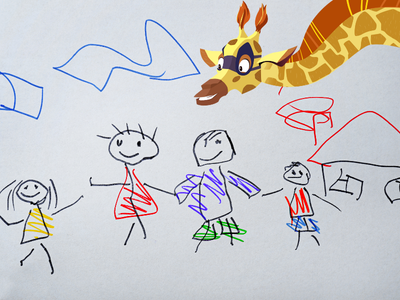
We wholeheartedly support allowing your children to use their imaginations and create some magic. Inevitably, when you don’t accept a child’s creativity you stifle them.
We address this in the very opening scene of our first book, Night Zookeeper: The Giraffes of Whispering Wood:
“ Will Rivers took a step back from the wall. He clamped the end of his paintbrush between his teeth and admired his work. Well, his painting was certainly big. And purple. Very purple. Will smiled with satisfaction. He has captured the shape and features really well. It looked great. Almost perfect in fact.
A voice next to him said, ‘Oh mate, what have you done?’
Will hadn’t noticed his friend Isaac come and stand next to him. Isaac was examining Will’s painting with a sour look on his face.
‘I mean seriously. That’s not how an elephant should look,’ said Isaac.”
- Excerpt from Night Zookeeper: The Giraffes of Whispering Wood.
We obviously disagree with Isaac. He’s supposed to be Will’s friend, and instead he’s telling him to stay inside the box. For us, an elephant can certainly be purple, and they can time-travel, in fact! Just ask Maji the Time-Travelling Elephant. She’s one of the heroes of the Night Zookeeper series who guides our protagonist Will Rivers through his journey as a Night Zookeeper. He (and we) would be lost without her.
Our point here, is that if you only provide restrictions, your child will only strive to stay within the box (e.g. painting an elephant grey). This stifles originality. You don’t want your creative child only producing things that are standard and acceptable just because it’s already been done and is the “right” thing to do. This might prevent them from thinking outside the box later on in life.
Give them permission to make unexpected choices, even when those choices don't immediately make sense to you.
Give them space to be bored
It might sound strange, but boredom can be a useful part of the creative process.
Children don't need to be entertained or directed every minute of the day. When there is nothing immediately telling them what to do, they have an opportunity to invent something themselves.
Rather than immediately reaching for a screen, suggesting an activity or filling every quiet moment, give your child some unstructured time. Let them decide what to do with it.
They might build something from cardboard, invent a game, draw a strange creature, make up a story or simply sit and think. It might even get messy!
That’s okay. Creativity rarely follows a perfectly organised process. Allowing children to make a mess, experiment and follow an idea wherever it leads can give them the freedom to discover interests and solutions independently.
Allow the freedom to explore
As parents, it’s natural to want to help. You might suggest what colour they should use, show them how you would complete a drawing, or give them ideas for where their story should go.
But sometimes the best thing you can do is step back.
Try not to over-schedule every part of their free time or place too many rules around creative activities. Give them a starting point, provide the resources they need, and then let them take the lead.
This doesn't mean leaving your child completely on their own. You can still be interested, ask questions and encourage them. The difference is allowing your child to make the creative decisions.
Instead of saying, “Why don't you draw a house?”, try asking, “What would you like to create?”
Instead of showing them how to make something, ask, “How do you think we could make this work?”
Giving children ownership over the process can encourage them to develop their own ideas and practice solving problems independently.
Focus on the process, not the finished product
When a child brings you a drawing, story, or craft project, it can be tempting to immediately praise how it looks.
But creativity isn't only about the finished product.
The process of creating gives children opportunities to experiment, make mistakes, change their minds, and try again. These experiences can be just as valuable as the final result.
Try asking questions such as “What was your favorite part to make?, "How did you come up with that idea?”, or "What would you change if you did it again?”.
This shifts the focus away from whether something is “good” or “bad” and towards curiosity and experimentation.
There doesn't always need to be a useful or impressive outcome. Sometimes creating something simply because it is fun is enough.
Provide creative resources
Sure, you could enrol your child in the most prestigious of programs, hire the most professional of tutors and buy the best new products to help your child flourish. If you’re fortunate enough to have access to these options, they can certainly help! But in regards to creativity, sometimes all a child needs to start with is a piece of paper. Provide them with art supplies, pens and paper.
As an additional challenge, make yourself think outside of the box. Throwing out cardboard shoe boxes, packing materials or leftover cardboard tubes from kitchen roll? They could be a canvas for a painting or the base for a sculpture! It’s also a great way to introduce sustainability to your children by teaching them to reuse things.
Give them the materials and see what they decide to do with them. You may be surprised by what they come up with!
Encourage clubs and after-school activities
If your child goes to a public school, often there are options for creative after-school activities. If they are available, encourage your child to join different after-school clubs. Not only will they meet other children who share the same interests, but they will also get extended exposure to creative outlets. Whether they join the school play, art club, or even language club – these creative outlets are a good way for your child to learn to express themselves in a non-academic way.
If your child is homeschooled, research local groups that are focused on creative outlets, like painting club, book club or general homeschool meetups. We also recommend researching local Homeschooling Facebook groups in your area – many of which provide special meetups.

Lead by example
The proof is in the pudding. Children learn by example, and the person they are most around is you, their guardian! If you lead by creative example, then your children will feel free to follow suit. Similarly to reusing household items for your child’s artistic benefit, we recommend you think of ways to introduce creativity into your own life to help your child’s own creativity.
Even if you aren’t a creative person, that doesn’t mean you can’t help your child co-pilot their creative process. Let your child guide you, but you can get involved with helping them to write a story, posing interest and thought-provoking questions to get their imaginations jump-started. Or, you can help your child paint their next masterpiece. Your involvement in their work lets them know you support them and allows them to think more freely.
Just remember to leave room for their ideas too. Your involvement in their work lets them know you support them, while stepping back allows them to think more freely.
Expand their horizons
Now, we’re aware that everyone has different budgets so we’re not suggesting that you whisk your child away to another country on holiday for culture and art, if you can’t afford that. We are suggesting getting your child out of the house and taking them for experiences. Instead of going to the toy store, bring them to a museum or gallery. Expose them to a bit of culture.
Even going on a lovely walk outside to a park is a great way to start conversation with your child and encourage them to start expressing themselves.
You don't necessarily need to turn every experience into a lesson, either. Let them notice things, ask questions, collect interesting objects, make up stories about what they see and follow their curiosity.
Encourage reading early
Encourage them to read and do it often. Read to them. Read with them. Listen to them read to you. Give them space to read by themselves and explore whole new worlds of wonder. Reading shows them that creativity and magic is endless and that they too can start crafting stories of their own. Additionally, the more they read, the more exposed they get to sentence structure, grammar and plot development, which can influence their own writing and ideas further down the line.
Most importantly, let them explore books that genuinely interest them. Their reading doesn't always need to be chosen by an adult or connected to a particular assignment. Following their own interests can help them discover new ideas and stories.
Limit distractions
Technology is a wonderful thing. There is no separating children from a world of technology (and we don’t think you should!). However, guiding children towards the right kinds of technology is crucial. Rather than being passive consumers, strive to direct your children towards technology that gives them a sense of agency. Too easily, many television programs, apps and video games absorb a child’s attention in a non-productive way. Strive to find the right technology the engages their spirit and their mind, simultaneously.
And remember, limiting distractions isn't only about screen time. Sometimes children need a break from constant stimulation altogether. Quiet time, boredom and unstructured play can give them the opportunity to create without being prompted.

Play games with them
We’re big proponents of playing different games with your children to help boost creativity.
Creative games don't need to have complicated rules or expensive equipment. In fact, making up your own games can be even more creative.
Try giving your child a simple starting point and letting them change the rules, invent characters or decide what happens next. The aim isn't necessarily to win - it's to experiment, imagine and have fun together.
If you need help thinking of creative games to play with your child, here’s a list of some you can get started with!
Get them started on Night Zookeeper
Like we demonstrated earlier in creating one of our purple heroes, Maji the Time-Travelling Elephant, Night Zookeeper strives to let your child’s creativity flourish. Night Zookeeper makes learning to write easy and fun. From creating magical animals, to writing about them, to sharing them with an entire community of young writers, your child will surely be able to explore their creative potential.
Most importantly, Night Zookeeper gives children a space to experiment with their ideas. There isn't just one “right” way to imagine a magical animal or tell a story. Children can make unexpected choices, explore their interests and develop their own ideas while building their reading and writing skills.
Sign up today and get a FREE 7-day trial!
Got any questions? Email us at [email protected]. Follow us on social media for more tips:


Make Reading & Writing Fantastically Fun!
- Award-winning reading & writing program for kids
- Improves spelling, grammar, punctuation & vocabulary
- Over 1,000 different learning games and activities


How Creative Writing Can Help Children with Anxiety


7 Top Creative Activities To Do at Home